Thursday, September 04, 2008

Bioware, creators of Neverwinter Nights have announced the Dragon Age™ Toolset. It looks like it will allow students to create computer games similarly to Neverwinter Nights.

The following quoted from their web site :
  • Create Original Adventures – Using the rich set of Dragon Age assets and locations as starting blocks, users can modify these stunning areas by adding new quests, characters and scripting to craft their own adventures, fate–defining conversations and cut–scenes.
  • Powerful Script Editor – Users can fully customize combat and creature AI, allowing them to create detailed action sequences full of heart-pounding party–based tactical combat.
  • Content Creators Community – BioWare plans to have a dedicated community area online where content creators can share content easily and get content updates for the toolset.
  • On–Going Toolset Content Updates – BioWare plans to release additional assets and features for the toolset in the future, allowing for expanded creation of new areas.

BioWare has a long history of delivering powerful content–creation toolsand support to its community. In 2002, the studio released a Toolkit for the ever popular Neverwinter Nights™ which has allowed fans to create over 5,000 adventure modules of their own design, the most fan-created content in BioWare's history. Fans have not only created stand-alone adventures with the trailblazing Neverwinter Nights toolset, they still continue to create modules, five years after its original release and have crafted thousands of completely new monsters, hundreds of thousands of in–game objects (eg. weapons, armor, food, special effects, building facades, etc.) and dozens of worlds.

For more information about Dragon Age™: Origins, the latest updates, or to join BioWare's Dragon Age community, visit www.dragonage.com

Labels: , , ,

Sunday, February 17, 2008

Playing Saving Adryanee

Saving Adryanee is a learning game by Dr Sebastian Loh of Southern Illinois University Collaboraty for Interactive Learning Research (CILR). It is a playable module for Neverwinter Nights made with the Aurora Toolset.

I was lucky to have the opportunity to play this game which is not yet released as it is still under development. I won't give too much detail because it is not the final version and I wouldn't want to bias any trials.

Adryanee is sick and to save her, you need to discover some nutrition facts and collect some medicines. It is a quest game like World of Warcraft where information and items are 'dropped' by NPC's (Non Player Characters).

The game took me around 2 hours but I could now re-run it in 10 minutes. Embedded in the game are 3 nutrition based facts associated with a general idea of poor nutrition causing diseases. The game could be played without processing this information because it was not actually necessary to recall the information. Once you had 'learnt' the fact, your avatar 'knew' the fact and this altered NPC interactions. There was never a dialogue choice that depended on correct recall or application of a fact. There was also a theme of problem solving being research based and not about superstitious learning. Facts should be tested.

Nevertheless my attention was focused on these facts because I expected that they would be relevant in solving the game.

The learning content was well integrated into the game, in the sense of endogenous fantasy (Malone and Lepper)

In terms of playability and engagement, I found the game too hard and not rewarding. Detailed searching of NPC's and objects is not my idea of fun though it may well suit other playing styles. It should be noted that it is a game under development and that it will no doubt be modified as a result of further playability trials. What was absent was the ability to match the level of difficulty to the players ability. Also missing were interim rewards.

Consider the learning on these criteria:
Declarative knowledge
I can recall all three disorders and their cures because I was engaged but recall was not necessary to play the game. My recall is enhanced because I already knew these 3 facts. 3 facts in 2 hours is not a high information density.

Procedural knowledge
At no stage was I required to use the declarative knowledge. If, later in the game, I was required to correctly diagnose and treat NPC's, the knowledge would cease to be 'inert' knowledge and be better retained. Though my avatar assembled and evaluated data with a scientific method, the player was not required to evaluate. It was scientific method by example not by practice.

Problem solving
Have my problem solving skills been improved? What do I take away that might allow me to do evidence based research. Might my skills at solving infectious disease or forensic medicine problems be enhanced? I was shown by example, causality, evidence, evaluation of evidence but I was not ever problem solving in this domain. I was doing a lot of problem solving in the game domain. I knew I needed to get into the inn and I knew what items I needed. I was second guessing the game designer and drawing on my experience in playing similar games.

Watch this space. Its early days for learning games. The Aurora Toolset has a lot of potential for the cost effective creation of content. Purpose built modules like this can have inbuilt audit trails, see Loh, Designing Online Games Assessment as “Information Trails”

A big thank you to Dr Sebastian Loh for making this game available despite power outages and deep snow at that time. A dwarf walked up to me and gave me advice, it took a sentence of dialogue or two to be sure it wasnt a NPC, It was Sebastian, thanks!

Labels: , , ,

Thursday, January 31, 2008

Learning Games with Neverwinter Nights

Neverwinter Nights is attracting a bit of interest for educational games because of the ability to do mods with its Aurora Tools. NWN is your classic 3D dungeons type game, it can be played single player or multiplayer. Its a bit like WoW and other games where your avatar has an inventory, health and other attributes and goes on quests. Aurora Tools is a level editor, like all those editors in strategy games, but it includes a scripting language and is very sophisticated in what it can do.

So what can you do educationally? You can run round killing stuff, explore dungeons, collect items and talk to NPC's. The ability to customise dialogue is a lot of what is interesting educators. You can deliver content, declarative knowledge. It also has prospects for procedural knowledge, problem solving. It is not too hard to drive and kids could make their own educational games. The best way to learn something is to teach it. It would lend itself to kids making a game in a second language, its style and dialogue editor lean towards text rich games. Kids could make an educational game in any area, learning content, problem solving, programming and computer skills.

I purchased NWN Diamond Edition (from Amazon).

First to note is that you need a DVD drive
also
Win 98+
P3 800MHz +
128MB, 4 GB, 32MB video

Out of the box, it wont run on Vista but can be patched, see tech support, also I had problems with the CD keys, if it happens to you see also tech support.

After playing the Prelude level, it was time to play with Aurora Tools. There is no help packaged with Aurora Tools but Google found me a tute at http://nwn.bioware.com/builders/toolsetintro.html

The learning game that you create is a module. Each module is made of a number of areas. The areas might be outside and inside a house or different caverns in a dungeon, but they are areas connected by doors. Each area is loaded separately in memory so there is really no geographical relationship between areas, you effectively teleport out one door of one area and into the door onf another. Like Dr Who's Tardis, there need not be a correspondence with the inside and outside shape of a building.

When you start Aurora, a wizard prompts you to use a tileset, interior, exterior, dungeon etc. For my first area, area1 I chose a city interior. In Aurora, the top view looks like this.
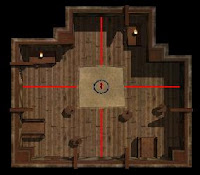

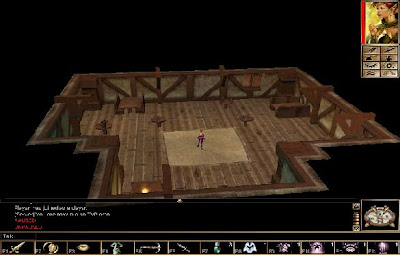
The symbol in the centre is the player's start position. You can run the game (build test module) or F9. Here is a screenshot of the game playing, you can walk round the room.

Quit out of the game and go back to Aurora. On the right hand side is the menu of things you can add. If you click on the "paint terrain" button you get a list of rooms that you can add to the area.

If you click on "paint creatures" you get a list of creatures you can add.

First time I tried it I added a dwarf to the room. When I ran the game the dwarf immediately attacked and killed me. LOL
Add a girl on the human category to the area. Then open the conversation editor (tools conversation editor) Click on add. You can build up a "conversation tree" as shown

The NPC (girl) says the text in red, the blue items are the possible player responses. I saved the conversation as conversation1 and closed the editor.

Right click on the girl and click properties
At the bottom of the dialogue box, select conversation1 for the conversation
Close the dialogue box and press F9 to run the game. Left mouse click will initiate a conversation with the girl.

Next to create an outside area and doors (as in http://nwn.bioware.com/builders/toolsetintro.html)

Click "paint terrain" and add corridor exit
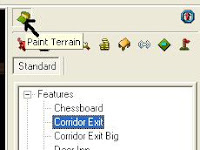
and add to the area
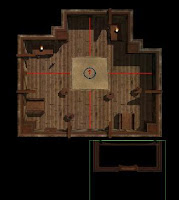

Then run the area wizard to create a second area (wizard area wizard), Name area002, rural tileset, medium size.

Add a house, (paint terrain, features, house1)

Then add a door to the door opening(paint doors, tileset specific, door)
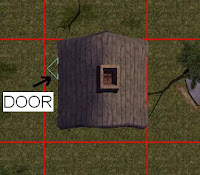

Paint the start location outside the house in area 2

Add a door to the door opening in the inside scene, area1. Right click on one of the doors on the list on the LHS, eg the door in area 1, properties, area transition tab, destination type door, set up area transition.

The target area is area2, target type door, connection type both ways, select the door. Yes, Yes,Yes to confirmation.

Run the game, you can walk inside and talk to the girl.

Labels: ,